One of the most common questions we receive: how do I file taxes for my LLC? The answer is that the IRS does not have a tax category called LLC. Before the tax question gets answered, a different question has to be answered first. How is your LLC currently being taxed?
Quick Answer
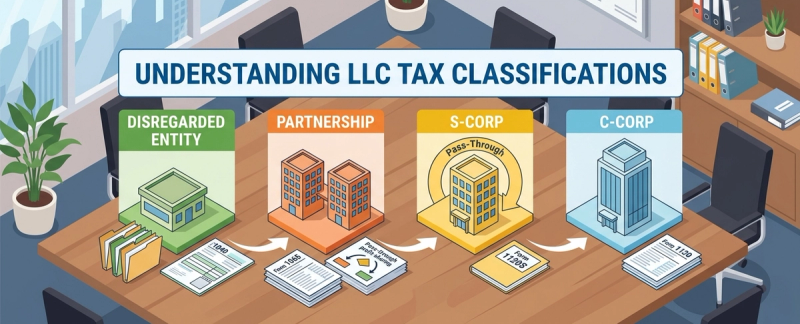
An LLC is taxed under one of four classifications: disregarded entity (default for single-member), partnership (default for multi-member), S-Corp (by election on Form 2553), or C-Corp (by election on Form 8832). The default applies automatically. The election changes how the LLC is taxed without changing the legal structure.
1. Disregarded Entity (Single-Member LLC)
If you are the only owner of your LLC and you have not made any tax election, this is your default classification. You may not have known you were in one.
All income and expenses flow directly to your personal return through Schedule C. For tax purposes, the IRS treats the LLC as if it does not exist.
The cost most owners do not see coming: self-employment tax. As a disregarded entity, you owe 15.3% self-employment tax on net profit, on top of your regular income tax. The 15.3% covers Social Security (12.4%, up to the annual wage base) and Medicare (2.9%, with no cap).
This classification fits when: you are operating as a solo founder or freelancer, your profits are modest, and the cost of additional compliance is not yet justified by tax savings. It stops fitting once profit is high enough that the self-employment tax exceeds the cost of running an S-Corp election.
2. Partnership (Multi-Member LLC)
If your LLC has two or more members and no election has been filed, partnership is the default classification.
The LLC files Form 1065, an informational return. No tax is paid at the entity level. Each member receives a Schedule K-1 with their share of income, deductions, and credits, which they then report on their personal return.
Members who actively work in the business are generally subject to self-employment tax on their share of the income. Passive members may not be, depending on the facts and the operating agreement.
This classification fits when: you have two or more owners, you want pass-through treatment, and you are not yet at a profit level where the S-Corp election produces material savings. It is the right answer for most multi-owner service businesses in their first few years.
3. S-Corp Election (Single or Multi-Member LLC)
Electing S-Corp status is done by filing Form 2553 with the IRS. The election does not change your legal structure. It only changes how the LLC is taxed.
The LLC files Form 1120-S and issues a Schedule K-1 to each member. The income still passes through to members personally.
The advantage: as an S-Corp, you are required to pay yourself a reasonable salary as a W-2 employee. Self-employment tax (in the form of payroll taxes) applies only to the salary, not to the remaining distributions. For owners with consistent profits above the salary threshold, this can produce meaningful tax savings.
The cost: payroll administration, quarterly Form 941 filings, state-level payroll registration in every state where work is performed, and a separate business return. The IRS scrutinizes the salary level closely. Setting it artificially low to maximize untaxed distributions is the most-audited aspect of S-Corp compliance.
Whether the S-Corp election makes financial sense depends on your specific profit level and state. Our post on when to switch to an S-Corp covers the threshold question and the trade-offs in detail.
This classification fits when: profits are consistent and high enough that payroll tax savings exceed the added compliance costs, you are willing to run formal payroll, and your state recognizes the S-Corp election (not all do).
4. C-Corp Election (Single or Multi-Member LLC)
Electing C-Corp taxation is done by filing Form 8832. It is the least common LLC tax classification but it has its place.
The LLC is taxed as a separate entity at the federal corporate rate and files Form 1120. If profits are distributed as dividends, they are taxed again at the individual level. This is the double taxation that the C-Corp structure is known for.
The advantage: C-Corps can retain earnings inside the business, taxed only at the corporate level until distributed. They also have access to a broader range of tax-free fringe benefits for owner-employees and, for foreign owners, can simplify the personal-side filing picture.
This classification fits when: you are planning to raise outside investment from US institutional investors who require a corporate structure, you intend to retain significant earnings in the business, or you are working toward a future acquisition or IPO.
If you are still working out which classification fits your situation, a flat-fee consultation evaluates the trade-offs against your actual numbers.
5. Foreign-Owned LLC: A Special Case
If you are a non-US resident who owns a US LLC, the classification rules are the same but the filing obligations are different. This is not a fifth classification. It is the disregarded entity or partnership treatment with additional reporting.
- Form 5472 obligation: a foreign-owned single-member LLC must file Form 5472 with a pro forma Form 1120 every year, even with no income or activity. The penalty for failing to file is $25,000 per form per year.
- ECI vs FDAP classification: income from the LLC may be effectively connected income (active US business) or FDAP (passive US-source income). Each is taxed differently. Misclassification produces incorrect withholding and back-tax exposure.
- State-level filings: the federal disregarded status does not always carry through to state returns. California, in particular, treats foreign-owned LLCs differently.
Foreign-owned LLCs operate within their own compliance framework. Our complete guide to Form 5472 filing requirements covers what counts as a reportable transaction and what the filing actually requires.
6. How to Choose Between the Four
The right classification depends on three variables: profit level, owner count, and your long-term plans for the entity. A simplified decision frame:
- Single-member LLC under a modest profit level: default disregarded entity is usually correct. The S-Corp election adds compliance costs without producing meaningful savings yet.
- Single-member LLC with consistent profits above the threshold: S-Corp election typically saves more than it costs, assuming you are willing to run payroll and your state recognizes the election.
- Multi-member LLC, owner-operated, no outside investors: default partnership is usually correct. S-Corp election is possible but the salary requirement applies to each active owner separately.
- LLC planning to raise institutional capital: C-Corp election (or formal conversion to a Delaware C-Corp) is typically required by US venture investors. The election should happen before the priced round, not after.
- Foreign-owned LLC: default treatment applies, but Form 5472 obligations and ECI/FDAP classification need to be reviewed before the first year ends.
State-level treatment can change the answer. Some states do not recognize the S-Corp election. Some impose franchise or minimum taxes that change the cost calculation. The federal answer is the starting point, not the final answer.
7. Changing Classification Later
Classification can be changed, but the rules are strict and not always reversible.
- S-Corp election deadline: Form 2553 must be filed by March 15 to apply to the current tax year for existing entities. New entities have 75 days from formation. Late election relief is available in limited circumstances.
- C-Corp to S-Corp: allowed but with built-in gains tax exposure on appreciated assets if the entity converts within five years.
- S-Corp or C-Corp back to disregarded entity: treated as a deemed liquidation for tax purposes. Can produce gain recognition as if assets were sold at fair market value.
- State-level coordination: some states require their own election forms separate from the federal Form 2553 or 8832. Missing the state election while making the federal one creates mismatched treatment.
This post is for general informational purposes only and does not constitute professional tax, legal, or accounting advice for your specific situation. Reading this post does not create a CPA-client relationship. Tax laws are complex and subject to change. If you would like advice tailored to your situation, consult a qualified tax professional, including through the services offered on this site.