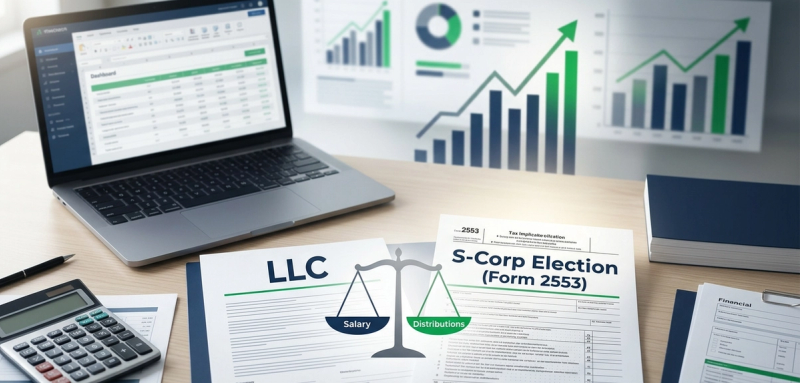
One of the most common tax planning questions we receive: should I switch to an S-Corp? The answer depends on where your business is financially, not on whether you have heard that the S-Corp saves taxes. Here is how to think through it.
Quick Answer
The S-Corp election makes sense once profits are consistent enough that the self-employment tax savings on your distribution exceed the cost of running payroll and filing a separate Form 1120-S. The exact threshold varies by state, but the underlying math is the same.
1. What the S-Corp Election Actually Does
First, a clarification. The S-Corp is not a separate legal entity formed at the state level. It is a tax election. You make the choice by filing Form 2553 with the IRS. Your underlying LLC or corporation stays exactly the same on paper. Only how you are taxed changes.
If you are not sure how your LLC is currently taxed, start with our LLC Taxation guide. The S-Corp election only matters relative to whatever default classification you are in today.
2. How the Tax Savings Work
As a sole proprietor or single-member LLC, the IRS treats your net profit as personal income. On top of regular income tax, you owe self-employment tax of 15.3% on that profit, made up of Social Security (12.4%, up to the annual wage base) and Medicare (2.9%, with no cap). Above the wage base, only the 2.9% Medicare portion applies. High earners may also owe an additional 0.9% Medicare surtax.
As a self-employed person, you pay both the employer and employee sides of those taxes.
With the S-Corp election, the same income gets split into two pieces:
- The salary: you are required to pay yourself a reasonable salary as a W-2 employee. Payroll taxes apply to the salary, equivalent to self-employment tax but split between you as the employer and you as the employee.
- The distribution: any profit left over after the salary is paid out as a shareholder distribution. Distributions are not subject to self-employment or payroll tax. This is where the savings come from.
A worked example: net profit of $150,000. Reasonable salary set at $80,000. Payroll taxes apply to the $80,000. The remaining $70,000 is distributed without payroll or self-employment tax. The $70,000 is still subject to regular income tax. The savings are specifically on the payroll tax portion, not on income tax.
3. The Compliance Costs
To maintain the S-Corp election, you take on obligations a sole proprietor does not have:
- Payroll: you are an employee of your own business. That means setting up a payroll system, running payroll regularly, calculating federal and state payroll taxes, and making timely tax deposits. Transferring money to yourself and calling it salary at year-end is not how this works.
- Quarterly Form 941: filed every quarter to report payroll taxes withheld and paid. Most states have an equivalent quarterly filing for state withholding and unemployment.
- Form 1120-S: the S-Corp business return, due March 15 each year (March 16 in 2026 because March 15 is a Sunday). Issues a Schedule K-1 to each shareholder.
- State requirements: not all states recognize the S-Corp election. Some tax S-Corps at the entity level. Some impose a franchise or minimum tax regardless of the federal election.
4. The Profit Threshold
The election makes sense above a certain profit level. Below that level, the fixed compliance costs exceed the variable savings.
The savings come from the gap between your total profit and your salary. The wider the gap, the more you save. The compliance costs are roughly fixed. They do not scale with profit.
At lower profit levels, the gap is small, the savings are small, and they do not cover the additional accounting and payroll costs. At higher profit levels, the gap widens and the savings grow while costs stay flat.
Most owners begin to evaluate the election once profits are consistent enough that the math obviously works in their favor. The exact threshold depends on your state (some have additional entity-level taxes that change the calculation), your willingness to run payroll, and how stable your income is year to year.
If you are close to the threshold and want to know whether the numbers work for your specific situation, a flat-fee planning consultation runs the math against your actual profit and state.
5. The Reasonable Salary Requirement
This is the most-audited part of the S-Corp election.
The IRS knows S-Corp owners are incentivized to pay themselves as little salary as possible to maximize the untaxed distribution. To prevent abuse, your salary has to be reasonable for the work you do.
What reasonable means: the salary should reflect what you would pay someone else to perform the same role. The IRS evaluates this against industry benchmarks, your qualifications, the time you spend in the business, and pay at comparable businesses.
The most common failure pattern in S-Corp compliance is not setting the salary too low. It is setting it correctly in concept but running it incorrectly in practice. The salary needs to flow through actual payroll throughout the year, with quarterly Form 941 filings, federal and state deposits, and a W-2 issued at year-end. Setting a number on paper and then back-dating the payroll at year-end does not produce a defensible position.
Documentation matters. The basis for your salary should be on file when you set it: industry data, comparable role research, time allocation. If the salary is challenged, the documentation is what defends it.
6. The Election Deadline
- Existing businesses: Form 2553 has to be filed by March 15 to apply to the current tax year. After March 15, the earliest the election applies is the following tax year.
- New businesses: 75 days from the date of formation to file Form 2553 and have the election apply from day one.
- Late election relief: the IRS allows late S-Corp elections under Rev. Proc. 2013-30 in cases where the business intended to make the election but missed the deadline. The relief is not automatic and the criteria are specific.
7. When the Election Does Not Make Sense
Even with the right profit level, several situations make the S-Corp election the wrong choice:
- Inconsistent profits: if your income varies significantly year to year, fixed compliance costs can exceed savings in lower-income years. You are committed to running payroll and filing quarterly returns regardless of how the year goes.
- Plans to raise institutional investment: S-Corps have strict shareholder restrictions: no more than 100 shareholders, all must be US individuals (with limited exceptions), and only one class of stock. Most US venture investors require a C-Corp structure.
- Foreign owners: non-US residents cannot own an S-Corp. The election is unavailable if any owner does not meet the US person requirement.
- Passive owners: if you are not actively working in the business, the reasonable salary requirement becomes harder to apply. The election may not produce the same savings for passive owners.
- State tax considerations: some states impose additional state-level taxes on S-Corps that partially offset the federal savings. Run the numbers at both levels before electing.
Once the S-Corp election is in place, the entity-level filing in March feeds into the personal return in April. Our 2025 Business Tax Checklist covers what is required at the entity level before the K-1 can be issued.
This post is for general informational purposes only and does not constitute professional tax, legal, or accounting advice for your specific situation. Reading this post does not create a CPA-client relationship. Tax laws are complex and subject to change. If you would like advice tailored to your situation, consult a qualified tax professional, including through the services offered on this site.