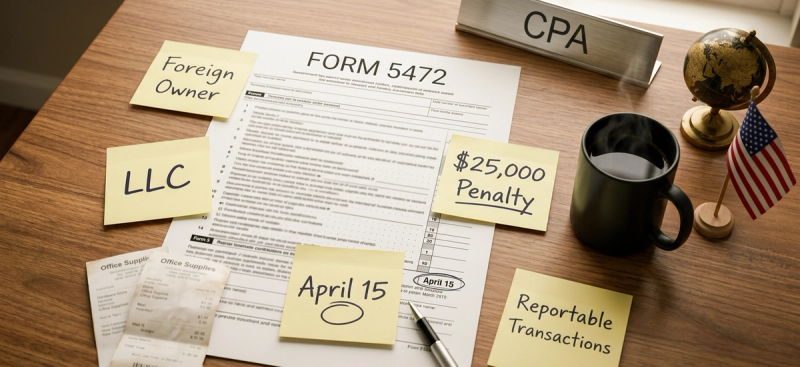
Form 5472 is one of the most commonly missed obligations in the US tax code, and one of the most expensive. The penalty starts at $25,000 per form per year and applies even if your business had no income. Understanding who has to file, what counts as a reportable transaction, and how to avoid the penalty trap is essential for any foreign owner of a US business.
Quick Answer
Form 5472 is an information return, not a tax payment form. The IRS uses it to track transactions between foreign owners and their US entities. Required under IRC Section 6038A and Section 6038C. Filed as an attachment to Form 1120 or Form 1120-F. Foreign-owned single-member LLCs file a pro forma Form 1120 specifically to attach Form 5472 to it.
1. Who Has to File
Three categories of entity have a Form 5472 filing obligation.
- Foreign-owned single-member LLCs: treated as disregarded entities for income tax purposes. Required to file Form 5472 with a pro forma Form 1120 every year, regardless of income or activity. This is the category most foreign founders miss because the LLC has no income tax return otherwise.
- US corporations 25% or more foreign-owned: any US corporation where 25% or more of voting power or value is held by a foreign person, directly or indirectly. One Form 5472 is filed for each related party with whom reportable transactions occurred.
- Foreign corporations engaged in US trade or business: with effectively connected income and reportable transactions with related parties. Filed attached to Form 1120-F.
If you are unsure how your LLC is currently classified for tax purposes, that question has to be answered first. The Form 5472 obligation flows from the classification.
Our LLC Taxation guide covers the four classifications and how disregarded-entity status works.
2. What Counts as a Reportable Transaction
The definition of a reportable transaction is broader than most foreign owners expect. The form is designed to capture money and property movements between the US entity and any foreign related party.
- Monetary transactions: any transfer of money. Capital contributions you made to fund the LLC, distributions paid back to you, loans in either direction. Even reimbursements of expenses you paid personally for the entity.
- Non-monetary transactions: transfers of property: equipment, intellectual property, real estate, inventory.
- Services: if you provide services to the US entity (consulting, management) or the entity provides services to you, the transaction is reportable.
- Rents and royalties: any rent or royalty payment between the US entity and a foreign related party.
The practical reality: in the year the entity was formed, there is at least one reportable transaction (the initial capital contribution that funded the entity). In most subsequent years, there are at least one or two more (distributions, additional contributions, expense reimbursements). Treating the filing as required is the safe default. Confirming an exception is something to do with a professional, not on your own.
3. The Pro Forma Form 1120
Foreign-owned single-member LLCs file Form 5472 as an attachment to a pro forma Form 1120. This is the most-misunderstood aspect of the filing requirement.
A pro forma Form 1120 is not a full corporate tax return. It is a simplified version that serves as a cover sheet for Form 5472. It includes basic identifying information about the LLC and the foreign owner. It does not require the LLC to calculate or pay corporate income tax.
Why it is required: a single-member LLC is a disregarded entity, so it does not file its own income tax return under normal circumstances. The pro forma Form 1120 is the mechanism the IRS uses to receive Form 5472 for disregarded entities. Without it, there is no way to file the 5472.
The filing process is generally by mail or fax, not e-file. Standard e-file systems do not fully support pro forma Form 1120 filings. The mailing address is in the IRS instructions and varies by location and whether payment is enclosed. Confirm the current address before mailing.
Form 5472 filing, Form 1120 preparation, and the year-by-year compliance review for foreign-owned LLCs are part of our international tax services.
4. Filing Deadlines
Filing deadlines depend on the entity type.
- Single-member LLCs (calendar year): April 15 for the prior calendar year. Form 7004 extends the deadline by six months to October 15.
- US corporations (calendar year): April 15 with the corporate return. Form 7004 extends to October 15.
- Foreign corporations: the 15th day of the fourth month after the close of the tax year, attached to Form 1120-F.
The extension is for filing only, not for payment. Although Form 5472 itself is not a tax payment form, if the underlying entity owes any US tax, that tax is still due on the original deadline.
The filing obligation begins in the year the entity was formed, not the year activity began. An LLC formed in October has a filing obligation for that partial year, due the following April 15.
5. The Penalty Structure
The penalty for failing to file, or for filing an incomplete or inaccurate Form 5472, is $25,000 per form per year. This is one of the highest information reporting penalties in the US tax code.
- Per form, not per entity: if a US corporation has three foreign shareholders who each meet the 25% threshold, the filing requires three separate Form 5472s. Failure to file exposes $75,000.
- Continuation penalty: if the failure continues beyond 90 days after the IRS notifies the entity, an additional $25,000 applies for each 30-day period the filing remains outstanding. There is no statutory maximum.
- No income threshold: the penalty applies whether or not the entity had income or activity. The filing obligation exists from the year of formation.
- Reasonable cause exception: the IRS can waive the penalty if the failure was due to reasonable cause and not willful neglect. The standard is high and not automatic.
6. The Statute of Limitations Trap
This is the part most owners miss, and it is structurally the most consequential.
The IRS audit window on a tax return is normally three years from the due date. For tax returns related to a missing Form 5472, that window does not start until the form is actually filed. Until then, the IRS can audit any item connected to the unfiled form, indefinitely.
Five-year-old transactions, ten-year-old transactions, transactions from the year the entity was formed: all remain auditable as long as the form for that year was never filed. Filing on time, even with zero transactions to report, is the only mechanism that closes the audit window.
The penalty and the statute of limitations are connected: missing a year creates the $25,000 exposure and keeps the audit window open on related items. Both clocks reset only when the form is actually filed. Catch-up filings start the three-year clock from the catch-up filing date, not the original due date.
7. Other Filings That May Apply
Form 5472 is rarely the only obligation. Foreign owners of US entities often have additional reporting:
- FBAR: if the LLC has financial interests in or signature authority over foreign bank accounts with combined balances over $10,000 at any point in the year, the LLC files FinCEN Form 114.
- Form 1040-NR: non-resident owners with effectively connected income from the LLC file a personal US return. The income flowing from a disregarded LLC is reported here.
- State filings: Delaware, California, and most other states require their own annual filings and franchise taxes regardless of federal status.
- Tax treaty positions: if your country has a treaty with the US, claiming reduced withholding or other benefits requires specific forms (W-8BEN, W-8BEN-E, Form 8833 in some cases).
For the broader picture of US tax obligations on foreign-owned entities, including the income tax side, our post on whether foreign-owned US entities pay US tax covers the full framework.
This post is for general informational purposes only and does not constitute professional tax, legal, or accounting advice for your specific situation. Reading this post does not create a CPA-client relationship. Tax laws are complex and subject to change. If you would like advice tailored to your situation, consult a qualified tax professional, including through the services offered on this site.