Back to Blog
Compliance & Operations

US Tax Residency vs Non-Residency: What Determines How You Are Taxed

April 9, 2026 12 min read TaxClaim
US Tax Residency vs Non-Residency: What Determines How You Are Taxed

Whether you owe US tax on income earned outside the United States depends entirely on one question: are you a US tax resident or a non-resident alien? The answer is not always obvious, and the IRS has specific rules for making that determination.

Getting it wrong in either direction creates problems. Residents who file as non-residents underreport worldwide income. Non-residents who file as residents claim credits and deductions they are not entitled to. Both create audit exposure.

This post covers how the IRS determines your status, what each classification means for your tax obligations, and what happens in the year you change from one to the other.

This applies to you if you are:

  • A foreign founder with a US entity who spends time in the United States
  • On an H-1B, L-1, F-1, O-1, or similar visa
  • A remote worker or digital nomad splitting time between countries
  • Moving into or out of the United States during the year
  • A green card holder who has been living outside the US

The Two Tests That Determine US Tax Residency

The IRS uses two tests to determine whether a non-US citizen is a US tax resident. Meeting either one makes you a resident alien for federal tax purposes.

The Green Card Test

If you are a lawful permanent resident of the United States at any point during the calendar year, you are generally treated as a US tax resident for that year, subject to start and end date rules in the year your status begins or ends. It does not matter how many days you were physically present in the US. It does not matter whether you lived primarily abroad. The green card alone is sufficient.

Residency under the green card test ends only when your status is officially revoked or abandoned. Letting a green card expire without formally abandoning it does not end your US tax residency. The IRS and USCIS operate on different tracks. You can lose your immigration status while still being treated as a tax resident.

The Substantial Presence Test

If you do not have a green card, the IRS counts your days in the United States over a three-year rolling period. You are a US tax resident for the current year if you meet both of the following:

  • At least 31 days present in the current year
  • A total of 183 days or more under the weighted formula

Not every day counts equally. Days present as a diplomat, certain government employees, teachers or trainees on J or Q visas, students on F, J, M, or Q visas, or a professional athlete competing in a charitable event are generally excluded. Days you were unable to leave due to a medical condition that developed while you were present in the US are also excluded.

How to Calculate Your Substantial Presence Days

The 183-day threshold is not a simple count of days in the current year. The IRS uses a weighted formula across three years.

  • Step 1: Count every qualifying day you were present in the US during the current year. That number counts in full.
  • Step 2: Count your qualifying days from the prior year and multiply by one-third.
  • Step 3: Count your qualifying days from the year before that and multiply by one-sixth.
  • Step 4: Add the three figures together. If the total is 183 or more, and you were present for at least 31 days in the current year, you meet the substantial presence test.

Example: 120 days this year, 90 days last year, 60 days two years ago. The calculation is 120 + 30 + 10 = 160. That is below 183, so the test is not met for the current year.

The weighted formula is why someone who has been splitting their time across multiple countries for several years can trigger US residency without ever spending more than four months in the US in a single year. The prior years follow you.

What US Tax Residency Actually Means

Unknown block type "table", specify a component for it in the `components.types` option

If You Are a Resident Alien

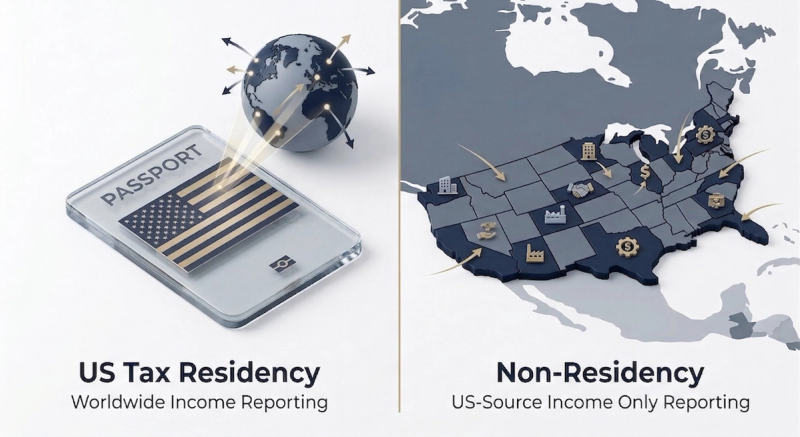
You are taxed the same way a US citizen is taxed. That means worldwide income, from every country, from every source, is subject to US federal income tax. Your salary from a foreign employer, your rental income from property abroad, your dividends from a foreign brokerage account: all of it goes on your US return.

You file Form 1040. Foreign tax credits and the foreign earned income exclusion may be available depending on your situation, but the obligation to report starts with all income, everywhere.

You may also have additional reporting obligations. If you have financial accounts outside the United States with aggregate balances exceeding $10,000 at any point during the year, FBAR applies. The FBAR deadline is April 15, with an automatic extension to October 15. If you hold specified foreign financial assets above certain thresholds, Form 8938 may also be required. These are separate from the income tax return and carry their own penalties.

If You Are a Non-Resident Alien

You are taxed only on US-source income. Income earned entirely outside the United States, with no US connection, is generally outside the reach of US federal income tax.

US-source income for a non-resident falls into two categories. The first is income effectively connected to a US trade or business, known as ECI, which is taxed at graduated rates on net income after deductions. The second is fixed, determinable, annual, or periodical income from US sources, known as FDAP, which is generally subject to 30% withholding on the gross amount, unless a tax treaty reduces that rate. Our post on how ECI and FDAP work for foreign-owned US entities covers both categories in full.

Non-residents file Form 1040-NR. Filing the wrong form is not a minor clerical issue. The forms produce different results.

The Closer Connection Exception

If you meet the substantial presence test but spent fewer than 183 days in the US during the current year, you may be able to claim a closer connection to a foreign country and avoid US tax residency for that year.

To qualify, you must have maintained a tax home in a foreign country during the year and had a closer connection to that country than to the United States. The IRS looks at where your permanent home is, where your family lives, where your personal belongings are, where you hold licenses and bank accounts, and where you conduct your business. You file Form 8840 to make this claim. The exception only applies if Form 8840 is filed on time.

The closer connection exception is not available if you have applied for adjustment of status or taken affirmative steps toward obtaining lawful permanent residency at any point during the year, such as filing an I-485 or similar application.

A note for digital nomads and remote tech workers:

Many remote workers assume that because their employer is not a US company, their days in the United States do not count toward residency. That is not how the IRS sees it. The substantial presence test looks at physical presence, not the location of your employer or the source of your paycheck.

If you spend four months a year in the US while working remotely for a company based abroad, those days count. Add the weighted prior-year days, and you may cross 183 without realizing it. In practice, we often see this situation arise when someone has been traveling in and out of the US for a few years without tracking their days. By year three, the prior years have already done most of the counting.

The Closer Connection Exception through Form 8840 is often the primary planning tool in this situation. Whether it applies to your specific circumstances depends on the facts, and those facts matter.

Tax Treaties and Residency Tiebreakers

If you are a tax resident of both the United States and a country with which the US has an income tax treaty, the treaty's tiebreaker rules may determine where you are treated as a resident for tax purposes.

Treaty tiebreakers generally look at where you have a permanent home, where your personal and economic relations are closer, where you have a habitual abode, and finally your nationality. These are applied in sequence, stopping at the first factor that produces a clear answer.

A successful treaty tiebreaker claim does not eliminate your US filing obligation. It limits what income the US can tax. You are still required to file a US return, disclose the treaty position, and report the income that remains taxable in the United States. The position is taken on a return, not simply declared.

Treaty benefits require proper documentation, timely disclosure, and in some cases specific forms. Assuming the benefit applies without taking the required steps means the IRS is not bound by it.

Dual-Status Tax Years

The year you arrive in the United States and become a resident is not a full resident year. Neither is the year you leave. These are dual-status years, and they are handled differently.

In a dual-status year, you are treated as a non-resident alien for the part of the year before you became a resident, and as a resident alien for the part after. Income is reported based on which status applied when it was earned.

The filing mechanics depend on your status at year-end. If you are a resident at year-end, you file Form 1040 as the primary return and attach Form 1040-NR as a statement covering the non-resident portion. If you are a non-resident at year-end, Form 1040-NR is the primary return and Form 1040 is attached as the statement. The two are not filed separately in either case.

Dual-status filers face restrictions that full-year residents do not. You generally cannot use the standard deduction. You cannot file a joint return unless your spouse makes a specific election under IRC Section 6013(g) to be treated as a full-year resident. That election allows you to file jointly and claim the standard deduction, but it also brings your spouse's worldwide income into the US return for the full year. The trade-off matters, and it should be evaluated before the election is made. Certain credits are also off the table for dual-status filers who do not make that election.

The dual-status year is where the most common mistakes happen. Worldwide income gets included in the non-resident portion. The wrong form gets filed as the primary return. The standard deduction gets claimed when it should not be. Each of these creates an amended return situation at best, and an examination at worst.

If you are on an H-1B, L-1, or O-1 visa and changed your status during the year, or if you received a green card mid-year, you very likely had a dual-status year that requires a specific filing approach.

First-Year Election

If you did not meet the substantial presence test for the current year but will meet it for the following year, and you were present in the US for at least 31 consecutive days during the current year, you may be able to elect to be treated as a resident for part of the current year.

To qualify, you must also have been present in the US for at least 75% of the days from the first day of that 31-consecutive-day period through December 31 of the current year. Days of absence of up to 5 per month are counted as days of presence for purposes of that 75% calculation. The residency starting date under this election is the first day of that 31-consecutive-day period.

Example: You arrive June 1 and remain in the US for the rest of the year with only brief absences. June 1 through December 31 is 214 days. If you were present for at least 161 of those days (75%), and you will meet the substantial presence test for the following year, you can elect to be treated as a US resident from June 1 of the current year. Your filing for that year would cover the resident period only, not the full year.

This is an affirmative election made on a timely filed return, including extensions. Missing the deadline means the election is not available for that year.

Whether the election is beneficial depends on your specific income and filing situation. It is not always advantageous.

State Tax Residency Is a Separate Question

Federal tax residency and state tax residency are not the same determination. Each state has its own rules.

Most states use a domicile test, a statutory residency test based on days present and maintaining a permanent place of abode, or both. A person who is a non-resident alien for federal purposes may still be a state tax resident if they spent enough days in a particular state and maintained a home there.

California and New York are the most aggressive in asserting residency. Simply leaving the state does not automatically end California or New York residency for state tax purposes. If you are moving in or out of a high-tax state in the same year you are changing your federal residency status, those are two separate analyses with potentially different answers.

Residency and Ownership of US Entities

Your residency status directly affects your obligations when you own a US entity.

If you are a non-resident alien and you own a US LLC, that LLC is treated as a foreign-owned disregarded entity, which triggers a Form 5472 filing obligation from the year of formation regardless of whether it has taxable income. The penalty starts at $25,000 per year. Our complete guide to Form 5472 for foreign-owned US entities covers the filing requirements, what transactions need to be reported, and what happens if filings are missed.

If you are a US tax resident and you own shares in a foreign corporation, Form 5471 may be required depending on your ownership percentage and level of control. The penalty starts at $10,000 per form per year, and missing it keeps your entire return permanently open to IRS audit with no time limit. Our post on Form 5471 filing requirements covers who has to file and which category applies.

Changing your residency status without reviewing your entity filing obligations is one of the most common gaps we see.

Expatriation and Exit Tax

If you give up your US citizenship or long-term permanent residency, the US imposes an exit tax on certain individuals.

A long-term resident is someone who has held a green card for at least 8 of the past 15 years. If you are a long-term resident formally abandoning your green card, or a US citizen renouncing citizenship, you are a covered expatriate if you meet any of the following thresholds for 2026: average net annual US income tax liability over the past 5 years exceeds $211,000, net worth on the expatriation date is $2 million or more (including worldwide assets), or you cannot certify compliance with all US tax obligations for the prior 5 years.

Covered expatriates are treated as if they sold all of their assets at fair market value on the day before expatriation. The 2026 exclusion amount on mark-to-market gains is $910,000. Gains above that are taxed in the year of departure. Certain deferred compensation, interests in non-grantor trusts, and specified tax-deferred accounts are also affected.

Form 8854 is required in the year of expatriation. Failure to file it means you are treated as a covered expatriate regardless of whether you actually meet the thresholds. The numbers above are adjusted annually. What applies to your year of departure requires a current-year review.

Common Residency Mistakes and What They Lead To

Filing Form 1040 as a non-resident. Non-residents file Form 1040-NR. Using the wrong form can result in the standard deduction being applied incorrectly, worldwide income being excluded when it should be included, and credits being claimed that have residency requirements attached.

Assuming the green card is what matters for immigration, not taxes. Many green card holders who have lived abroad for years believe they are not US tax residents because they do not live in the US. Until the green card is formally abandoned through Form I-407 and a proper final return is filed, the filing obligation continues.

Counting days incorrectly under substantial presence. The weighted formula catches people who split their time between countries. They count 31 days in the current year and assume they do not meet the test, without running the full three-year calculation.

Treating treaty positions as automatic. A tax treaty can limit US tax obligations, but claiming the benefit requires proper disclosure, timely filing, and documentation. Assuming the benefit applies without taking the required steps means the IRS is not bound by it.

Missing the dual-status year entirely. People in transition years often file either a full-year Form 1040 or a full-year Form 1040-NR when neither is correct. This is not what most tax software defaults to, and it is not intuitive.

Each of these situations has a specific resolution path. What that looks like depends on the facts, how many years are involved, and whether the IRS has already made contact. If you are trying to sort out prior years or a current filing, start here.

This post is for general informational purposes only and does not constitute professional tax, legal, or accounting advice for your specific situation. Reading this post does not create a CPA-client relationship. Tax laws are complex and subject to change. If you would like advice tailored to your situation, consult a qualified tax professional, including through the services offered on this site.

Not sure where you stand? Let us work it out.

Flat fee. Fully remote. 100% on-time.

Frequently Asked Questions

How does the IRS determine if I am a US tax resident?

[object Object]

Do I pay US tax on foreign income if I am a non-resident alien?

[object Object]

What is a dual-status tax year and do I have one?

[object Object]

Can a tax treaty reduce my US tax obligations as a non-resident?

[object Object]

What happens to my US tax obligations when I give up my green card?

[object Object]